23 November 2026
Nikola Tesla's Birth Chart Explained
Nikola Tesla is remembered as the most disciplined mind in history: the man who barely slept, counted his steps and lived by strange, exact rituals. His birth chart tells a different story. And so, it turns out, does his life.
What follows is a reading of his natural tendencies, the personality his chart describes, set against what he actually did, often in his own words.
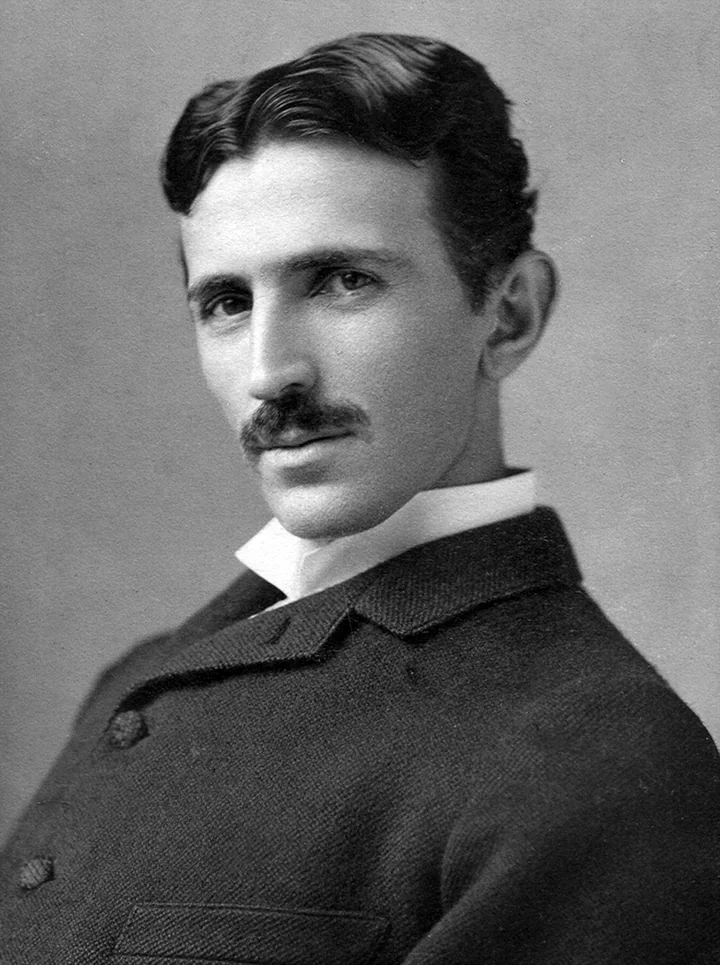
Born at the stroke of midnight
Tesla was born in Smiljan on 10 July 1856, at midnight. Family legend says a summer storm was raging outside. "He'll be a child of the storm," the midwife said. "No," his mother answered. "Of light."
Whether or not the lightning was real, the timing is famously quoted, and it is the time we use for his chart. He was born under a night sky, in summer, with the Moon in its first quarter.
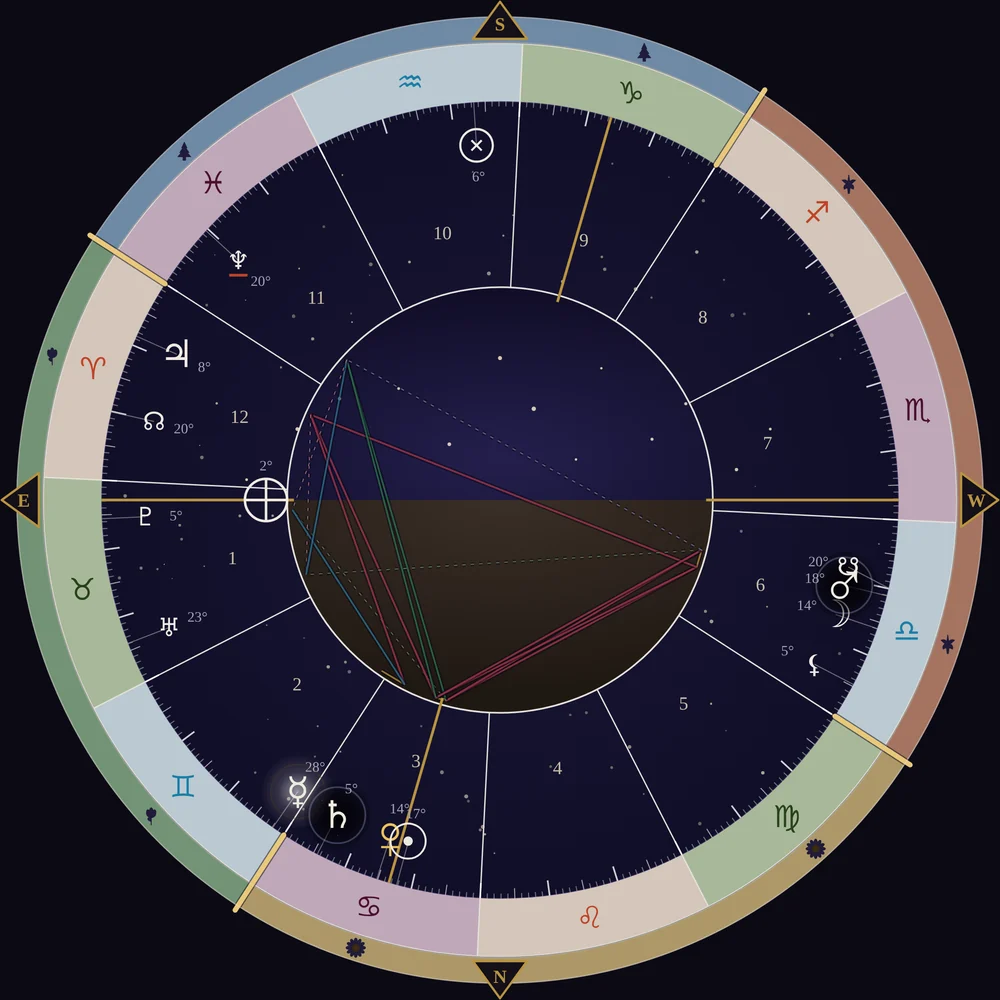
You can explore his chart yourself: open Nikola Tesla's interactive chart. Tap the glowing emblem under the chart to open the Chronosphere and travel through the sky around his birth.
The legend of discipline
Tesla claimed he slept two hours a night. He walked miles every day, wiped his cutlery with 18 napkins before a meal, and kept strict, exact habits for decades. In his autobiography, he described the compulsions behind them himself:
"I counted the steps in my walks and calculated the cubical contents of soup plates, coffee cups and pieces of food, otherwise my meal was unenjoyable. All repeated acts or operations I performed had to be divisible by three and if I missed I felt impelled to do it all over again, even if it took hours."
His aversions were just as precise:
"The sight of a pearl would almost give me a fit but I was fascinated with the glitter of crystals or objects with sharp edges and plane surfaces. I would not touch the hair of other people except, perhaps, at the point of a revolver. I would get a fever by looking at a peach."
Put together, these habits paint the picture most people carry of him: a man of iron discipline.
His chart shows something more interesting. It does show a natural love of calm, steady routines, and that part of him was real. But the extreme, obsessive side of his habits came from somewhere else. It came from passion: a deeply stubborn, motivated chase after whatever had caught his attention. If he made up his mind on a choice backed by that passion, Tesla was unstoppable. Everywhere else, he was surprisingly chaotic.
The gambler
The first place that chaos shows is the card table. As a student at the Polytechnic in Graz, Tesla fell hard for gambling. He later wrote:
"To sit down to a game of cards was for me the quintessence of pleasure."
In a 1925 newspaper piece about his mother, he described it even more plainly:
"When I was about twenty, I contracted a mania for gambling. We played for very high stakes; and more than one of my companions gambled away the full value of his home. My luck was generally bad, but on one occasion I won everything in sight. Still I was not satisfied, but must go on with the play. I lent my companions money so that we might continue, and before we left the table I had lost all that I had won and was in debt."
Notice the detail in the middle of that confession: he won everything, then lent his own winnings to his companions so the game could continue. Even at his most reckless, he was generous to the people around him.
He gambled away his allowance and never finished his degree. His chart shows exactly this pairing: a love of risk and fun, chased at times quite irresponsibly, alongside a real care for treating others well.
How it ended says just as much about him. When he came home still craving the game, his mother handed him a roll of money and told him: "Go and enjoy yourself. The sooner you lose all we possess the better it will be. I know that you will get over it." He did. Tesla wrote that he conquered his passion then and there. His chart shows a mind that weighs its choices slowly and carefully, then never lets go once it decides. That night, it decided.
The quick mind that never let go
His chart shows a quick, versatile and open mind, one that becomes stubborn and thorough the moment something truly captures it. Tesla himself described building entire machines in his imagination, running and adjusting them in his head before he ever touched a tool.
That is the real engine behind the "discipline." It was not willpower spread evenly across his life. It was obsessive focus, pointed at the things he loved.
Reckless with himself
Outside his work, the same man was careless to the point of ruin. He poured every dollar into his experiments. In 1916 he told a New York court he had no money and was living on credit at the Waldorf-Astoria. He paid off a $20,000 hotel debt by giving up his laboratory at Wardenclyffe. For the rest of his life he moved from hotel to hotel, often leaving unpaid bills behind. Even his famous sleep schedule was less a discipline than a symptom: he simply would not stop.
A trusting heart
This is where the story usually stops at "eccentric genius." But his chart shows much more than recklessness. It shows deep trust in people, a strong sense of fairness, and a love of exploration and freedom.
His love of risk carried him across an ocean. He arrived in New York in 1884 with, by his own account, a few cents in his pocket. His first investors used his arc lamp designs and then pushed him out of his own company, leaving him with worthless stock. He later called it the hardest blow he ever received, and for a time he dug ditches to survive.
His trust did not harden after that. His contract with Westinghouse paid him $2.50 for every horsepower of electricity generated by his alternating-current system, the very system that went on to power the entire world. Kept, those royalties would have made him one of the richest men who ever lived. But when the Westinghouse company, run by the man who had believed in him, fell into financial trouble, Tesla gave up the royalties for a one-time payment of $216,000. He did not press for what he was owed.
All in on the future
Tesla believed in the good the future could bring, and again and again he bet everything he had on it.
In 1899 he took $30,000 from the millionaire John Jacob Astor and built an experimental station in Colorado Springs. His experiments there were so powerful that they burned out the dynamo at the local power company and blacked out the town. After he left, the station was torn down, and its contents were sold at auction to pay his unpaid bills.
Then came Wardenclyffe, a tower meant to send messages and power around the world without wires. He poured his fortune, his credit and the backing of J.P. Morgan into it. When the funding was pulled, he kept going until there was nothing left, and the tower itself went to pay a hotel bill.
He never stopped imagining. In a 1926 interview, he described the future in remarkable detail:
"We shall be able to communicate with one another instantly, irrespective of distance. [...] A man will be able to carry one in his vest pocket."
The first call from a handheld mobile phone was made 47 years later, in 1973. The smartphone as we know it arrived in 2007, 81 years after his interview.
The gentle heart
The "lonely hermit" image misses who Tesla was. In the 1890s he was a star of New York society, a regular at Delmonico's and a close friend of Mark Twain, who visited his laboratory. His chart shows a great need for people and for acceptance.
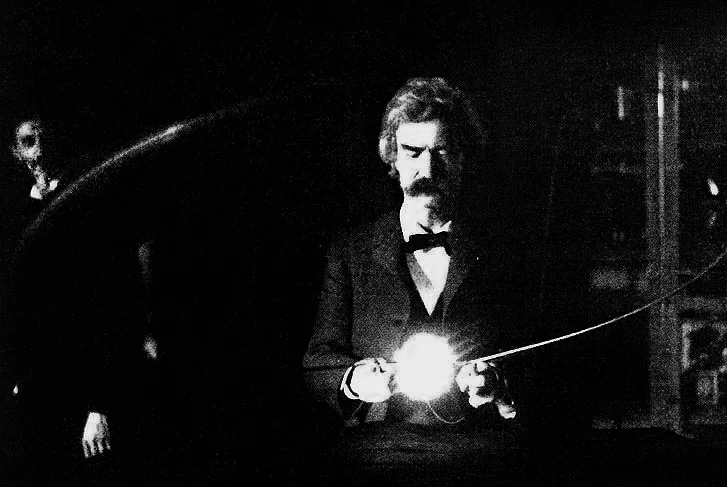
It also shows a gentle soul who was easily hurt by people. He remembered his hurts, but he carried them quietly rather than acting on them, and he tended to step away from unpleasant situations rather than fight them. Over the years he kept people at a distance, and turned instead toward what fed his curiosity.
Love, women and marriage
Tesla never married, but not for lack of feeling. He admired women deeply, and he explained his choice in 1896 in words that read almost like his chart:
"I do not believe that an inventor should marry, because he has so intense a nature and so much in it of wild passionate qualities that in giving himself to a woman he might love, he would give everything, and so take everything from his chosen field."
He was fascinated by women's minds, and he believed their rise would transform the world. He welcomed women educating themselves and predicted they would one day surpass men. What he disliked was women trying to become copies of men instead. In the same 1926 interview, he put it this way:
"It is not in the shallow physical imitation of men that women will assert first their equality and later their superiority, but in the awakening of the intellect of women."
He went further: "The female mind has demonstrated a capacity for all the mental acquirements and achievements of men," and in time, "the average woman will be as well educated as the average man, and then better educated."
His chart shows a man who would have been a loving, kind partner, though one whose first devotion would always have been to curiosity and discovery. He knew it, and he chose his work.
In his last years he fed the pigeons of New York every day and nursed injured birds in his hotel room. Of one white pigeon, he said: "I loved that pigeon as a man loves a woman."
The man in the chart
Tesla died on 7 January 1943, alone and in debt, in room 3327 of the Hotel New Yorker.
He was reckless with himself and generous with everyone else. A gambler, a dreamer and a gentle soul: every one of those tendencies is clearly visible in the chart of one of the greatest inventors who ever lived.
Learn to read a chart accurately
The readings on The Observatory come from the method in The Astrological Awakening, more than a decade of research into what a birth chart can and cannot tell us about a person. If you want to learn how to read a chart better than anyone, without fallacies, the book is where it starts.
Talk about it with us
Curious about something in Tesla's chart, or just want to talk about what you read? Come hang out with us on Discord and join the conversation.
Sources
- Nikola Tesla, My Inventions (1919), for his habits and aversions, his gambling, his mother's words and his habit of building machines in his mind.
- Nikola Tesla, "My Mother," The Buffalo Express, 27 December 1925: Tesla Universe
- "Nikola Tesla and Matrimony," Electrical Review, 14 August 1896: Tesla Universe
- John B. Kennedy, "When Woman Is Boss," Collier's, 30 January 1926: Tesla Universe
- "Tesla has only credit," New York newspaper coverage of the 1916 tax case: Tesla Universe
- Tesla Electric Light Company, 1885: Tesla Universe
- Colorado Springs, 1899: PBS
- The Waldorf-Astoria debt and Wardenclyffe: Mental Floss
- John J. O'Neill, Prodigal Genius: The Life of Nikola Tesla (1944), for his daily habits and the white pigeon.
Ask the Observatory
Have a question?
Send it in. We read your questions and answer them in future posts.
Thank you — your question is in. Keep an eye on The Observatory; it may be the next one answered.
Prefer to talk it through? Join the EtheReal community on Discord — questions, ideas, and the conversation as it happens.
Join us on Discord